Intro to Firetech
A Primer to accelerate your impact

Are you feeling moved to help prevent more disastrous fires?
I put this together to help accelerate your learning. This isn’t perfectly comprehensive because there is a lot to learn and be discovered, but it’s a good primer to get you started.
Who am I? My name is Preet Anand, a public safety inventor. I previously started and sold a company making 911 smarter and I started the safety technology area at Lyft, including personally leading its COVID response. I’ve spent years investigating Firetech because I look at Wildfires as one of the most tractable, high-leverage climate challenges in the world. I even have a patent on AI-enhanced fire detection and modeling.
In this primer:
Interventions before, during, and after a fire
Homework you can do this week to get smarter
Ways to get involved
More resources to explore
Why I believe Wildfire is such a high leverage area
Some final thoughts
Let me say three things up front before we dig in.
First, we can’t perfectly prevent a fire from starting. Whether it’s lightning strikes, campfires gone awry, or even arson, fires will happen. What we can control though is how we prepare for and respond to fires.
Second, many ecosystems need fire to be healthy. When they are at a healthy density, they are less vulnerable to extreme wildfire and have room for new growth.
Third, there are already a lot of amazing people working in this space. Be eager, but also be respectful.
Interventions along the lifecycle of fire
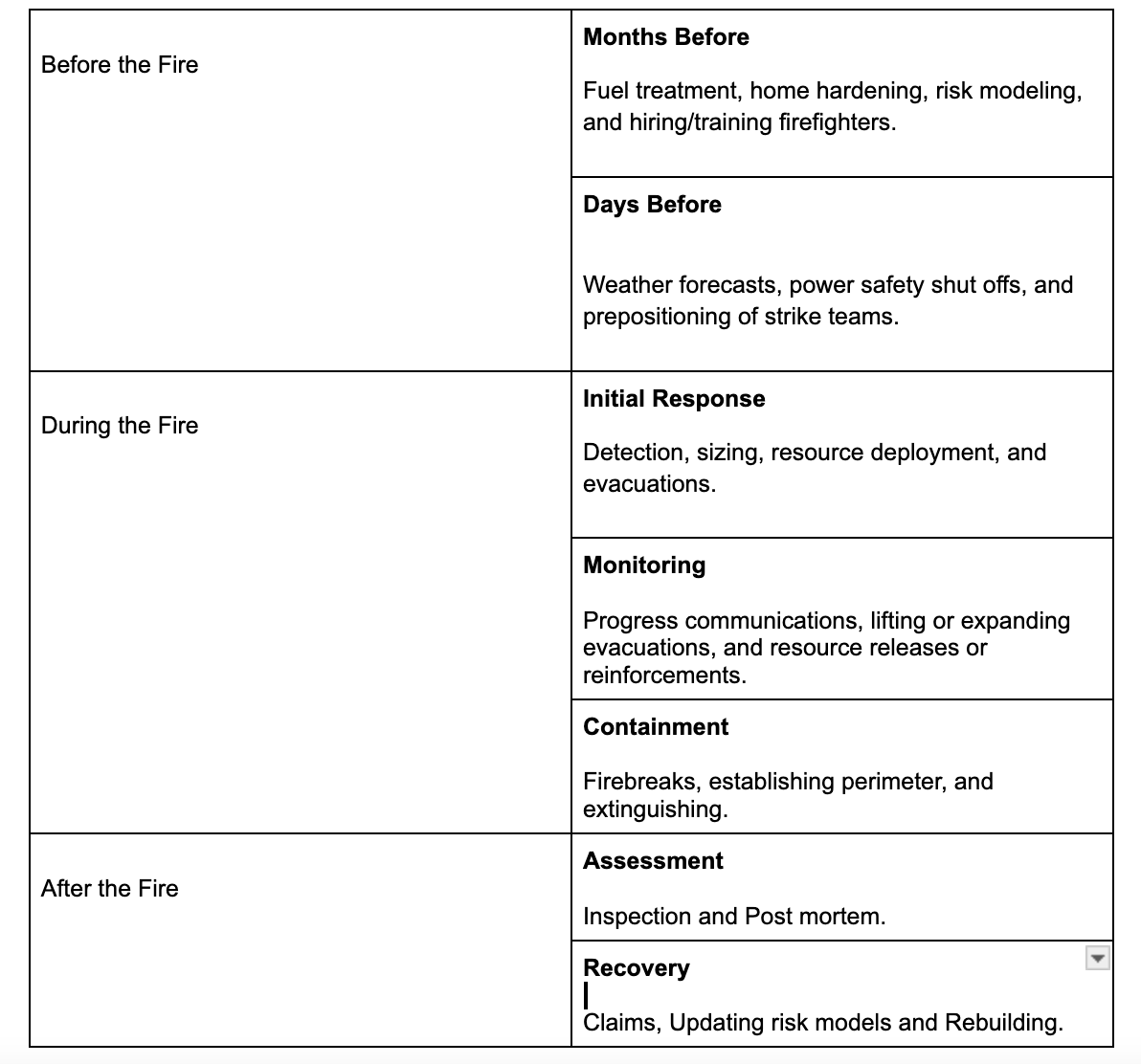
This is an overview of interventions possible within each phase: before the fire, during a fire, and after a fire. There is opportunity across all of them.
Before the fire
Remember, we can’t perfectly prevent a fire from starting but we can control how we prepare and respond to fires. That preparation starts before a fire.
It involves:
Fuel treatment
Home Hardening
Weather modeling
Risk modeling
Hiring & Training
Let’s unpack each. This is broken into interventions that are done months before and the ones that would be relevant days before. These aren’t done serially as some solutions, like home hardening, aren’t relevant to others.
Months before:
Fuel Treatment
Fuel treatment are simply actions to reduce the density of vegetation and flammable material in a given area. Vegetation management, prescribed burns, firebreaks, and thinning all fall under this.
Home Hardening
Homes are important and should be protected. Hardening, at both the individual structure level as well as community level, is the process of making changes to make the property better withstand fire. This can include upgrades like a stucco wall and multi-pane windows, as well as changes like removing landscape. When people talk about resilience or mitigation at the structural level, this is what they are talking about.
Risk modeling
The opposite side of hardening is risk modeling. It’s understanding how likely property is to be in a fireprone area, the likelihood of damage in the case of a nearby fire, and what the cost of fixing that damage would be. This is done at the home, neighborhood, town, and regional level. It informs resource planning and insurance underwriting. In a perfect market, hardening reduces insurance prices.
Hiring and Training
Firefighters need to be hired and trained before a fire. We need to have trained professionals at fire stations before crisis strikes. However, there is also need in community readiness.
Infrastructure and Equipment
Firefighters need to have the right equipment and infrastructure to appropriately respond. This includes working fire hydrants, maintained engines, vision, and redundant communications. The right tools are a force multiplier.
Days before:
Weather modeling
As we unfortunately saw in LA, weather affects fire behavior. If fire meets lots of dry vegetation on a hot windy day, it will rapidly grow. Weather modeling and forecasting informs when the most risky conditions are likely to be. Combined with risk modeling, this informs near-term mitigations like Power Safety Shutoffs by utilities and prepositioning of strike teams.
Power Safety Shutoff
This is when a utility turns off power to an area to denergize their power lines. Downed power lines have caused severe damage and trauma in multiple fires. To prevent this, Utilities will turn off power during “red flag warnings” when there is especially risky weather and fuel conditions.
Prepositioning
During risky weather and fuel conditions, equipment and strike teams will be prepositioned towards especially risky areas. This is to accelerate response time and prevent a small fire from becoming a catastrophic one.
During the fire
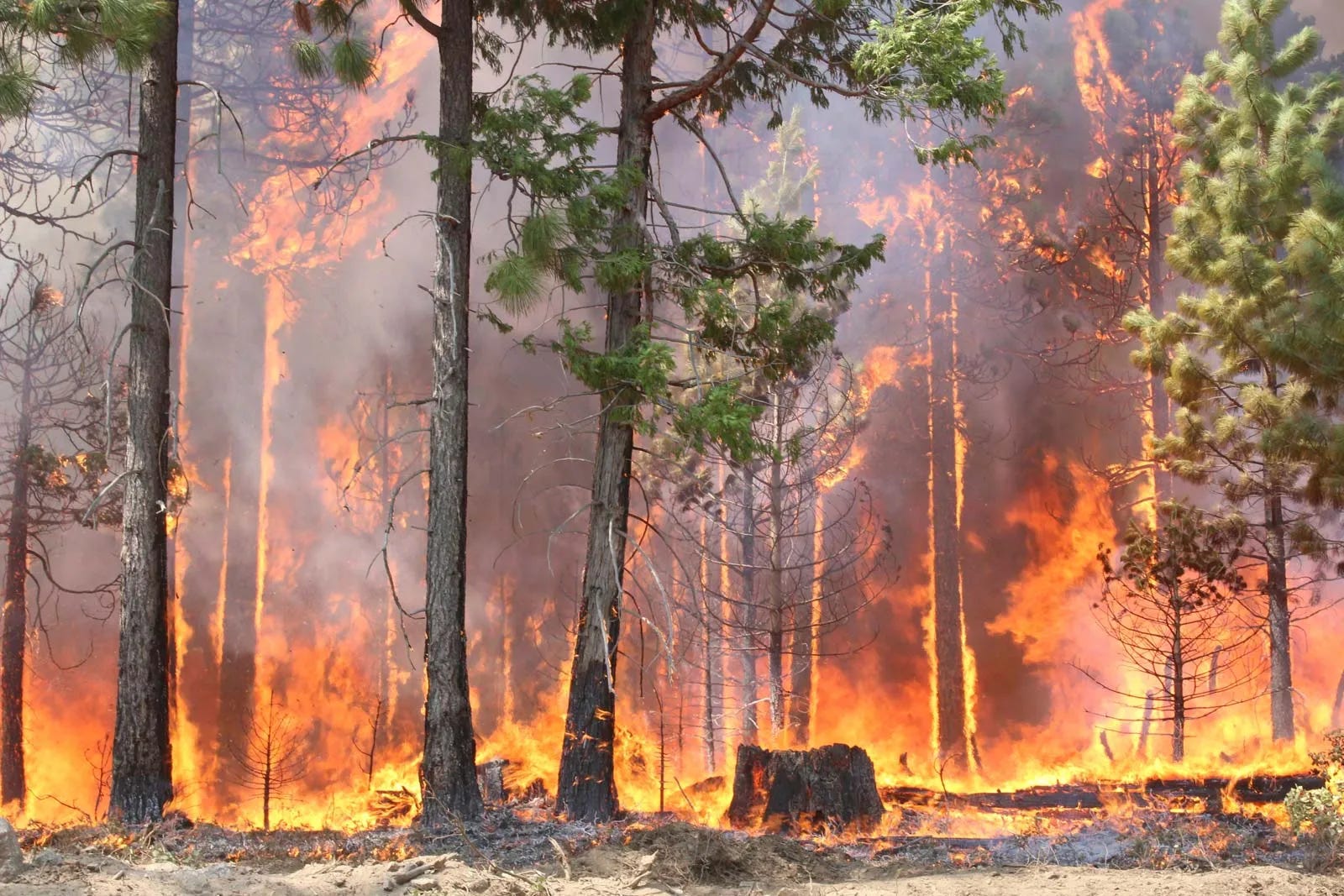
Once a fire starts, called ‘ignition’, there is a set of linear steps to make sure it burns safely and is contained. What firefighters do here is called Fire Operations.
It involves:
Detection
Sizing & Response
Monitoring & Evacuation
Containment
Suppression
Detection
The first step is simply knowing a fire has started. This can be detected through a smart, AI-enhanced camera that detects smoke or flame on the horizon. More commonly though this is a regular person seeing smoke in the distance and calling ‘911’ to report it in.
Sizing & Response
When the fire is detected, it’s important to know how big it is. This informs how big, if any, response is needed. If the fire is already somewhat big and it’s in a dry area on a windy day, you need to send a massive response to make sure it doesn’t grow out of control.
Based on the size, the response could be a single prepositioned team on a fire engine. On the other hand, it could be multiple engines and also planes and helicopters.
Monitoring
Based on conditions and the success of the response, the situation needs to be continually monitored. If operations are successful and progress of the fire has been halted, resources can be redeployed elsewhere. On the other hand, if the fire is still growing, more resources would need to be called in and evacuations are required to protect life and property. Communications are a critical underlying capability here to coordinate.
Containment
This is when firefighters attempt to stop a fire from growing further. They make firebreaks, deploy retardant, and use water to stop the fire from continuing to grow. Containment is establishing a perimeter that the fire will not grow beyond.
Suppression
After a fire is contained, firefighters may simply let it burn itself out. This can have the benefit of safely thinning out vegetation in an area. On the other hand, if it’s in a precious area like a neighborhood, firefighters will actively extinguish the flames. This is suppression.
After the fire
When the fire is over, there are still a lot of critical steps to take a full inventory of damage, learn from the event, and rebuild better.
It involves:
Inspection
Claims
Post Mortem
Updated Risk Modeling
Rebuilding
Preparing again
Inspection
Inspectors will identify where damage occurred, how extensive the damage was, and if there were any preventative measures in place. Fraud prevention is a critical aspect of this.
Claims
After damage is inventoried, claims are submitted with insurance. This is required in order to receive funds to rebuild.
Response Post Mortem
The Fire Operations group will do a post mortem and incident summary on the event. What caused the fire? Was the response adequate and timely? Was there anything unexpected? Were there any preparation failures? These are opportunities to learn and do better for future crises.
Updated risk modeling
The fire’s effects will inform all sorts of models and codes. Successful preventative measures, such as sprinklers, may be incorporated into building codes or investigated further. Simulation models will be updated based on fire characteristics. Geospatial systems will be updated to notate which areas were burned. Insurance premiums will change.
Rebuilding
After a fire, you need to rebuild. Lessons from the post mortem and insights from risk modeling need to be incorporated. That could mean more hydrants, different siding, and more hardening. It could also mean different density, more vegetation management, and fewer homes altogether.
Prepare
This is a cycle. There will be more fires in the future.
Homework you can do this week
Now you have a sense of the lifecycle of a fire. You know the types of interventions done to prepare for a fire and to respond well to it. Now let’s do some homework to put that into practice.
Go look at active incidents. View CalFire’s website and the National Interagency Fire Center’s website.
What are the active incidents?
How big are they?
What was the response? How long did it take to reach 50+% containment?
Go to Perplexity.ai and type in “What are Fire risks for [insert your neighborhood]?”.
What does it say? What are the sources?
Are there risks not being captured there?
Look at organizations innovating in this space and map them to the fire lifecycle I shared above.
Wildfires.org
Burnbot
Gridware
Stand Insurance
Frontline Wildfire Defense
Watch Duty
Put a few hours on your calendar to do these. I’m serious!
Ways to get involved
If you’ve gotten to this point, you either have a lot of time on your hands or you’re damn motivated. Ideally both because then you’ll make even more impact!
You probably already have ideas for how to get involved by now. Do those!
Here’s a few ideas though if you need inspiration:
Go check out the careers page of the organizations I shared above. See if there’s any roles that interest you. Apply!
See what your city’s Strategic Fire Plan is. See if the plan is updated and when the last time the city council reviewed it. As an example, San Diego County’s plan is the one through 2020-2025. It’s time to update it!
Advocate for defensive space. Check in with your elected officials and attend public hearings. Public pressure is critical for positive change.
Ask ‘Why’ about the interventions above and share your thoughts. Review a particular completed incident and get curious if there were alternative ways to accomplish that same need. Share it and get feedback! Sharpen your instincts. Ping me if you need a thought partner.
Volunteer with your local Fire department or Fire Council. Do home assessments. Create defensible space.
Attend a Prescribed Burn. See how they are done locally and what fuel management can look like. TREX also provides opportunities to be trained.
Find out how wildfire is affecting insurance rates in your area. Just like #4 above, ask what’s driving insurance rates in your area. Does it need to be that way?
Share this. There’s a lot of people interested in making a dent here. Share this to help accelerate their impact!
More resources
A few more resources I would check out for advanced reading are:
Convective Capital’s Resource page. It's an incredible set of overviews, deep dives, and links compiled by the only dedicated Firetech VC fund.
Firewise, which details practices for community resilience.
US Forest Service’s Wildfire Crisis page which details what’s being done. Updated to January 2025.
Indigenous practices of using fire for forest management. Native Americans used to manage most of the forests. There are definitely opportunities to learn.
Wildfire XPrize. Some cutting edge ideas for how to contain wildfires quickly.
Moore Foundations’ state of FireTech report. The Moore foundation is one of the largest private grantees for Wildfire Resilience in the USA.
Stanford Social Innovation Review essay about cross-sector innovation opportunity.
Me. Drop me a note if you have questions or ideas to discuss!
These are in addition to all the local resources you referenced, your own curious googling, linked sources from media stories, and the organizations mentioned above.
Why I believe Wildfire is such a high-leverage, ripe area for positive change
I believe Wildfire resilience is a high-leverage, tractable crisis. I believe that despite the tragedies of the past months.
There’s a few reasons why:
Wildfire is extremely concentrated. My analysis is that the 15 biggest fires of the past decade, out of thousands, represent 44% of acres burned in California. As another example, 50% of the world’s forests are in only 5 countries. Do better in a few places and there’s massive leverage.
Wildfire requires 10,000X fewer people to be convinced than something like EVs does to make positive change.
The negatives from megafire are so visually visceral and cut so widely. The pain involves lives lost, biodiversity lost, property damage, increased insurance costs, and terrible air quality. It’s comparatively easy to get alignment compared to other challenges.
For a complete list of reasons, read here.
Final thoughts
This is an urgent crisis that can be addressed with a lot of leverage. But it’s also an interconnected ecosystem with many parties and many dimensions. You have firefighters, land managers, environmentalists, policy makers, elected officials, residents, and insurance companies to name a few. There is opportunity at the policy dimension, process dimension, people dimension, product dimension, and even the pricing dimension.
My suggestion is to either build a broad coalition across groups or pick a very narrow problem to solve for a specific group.
The people of Los Angeles need your help. The world needs your help.
Learn, get involved, and make an impact!
If this was informative to you, please share it! This is an easy way to have an impact.